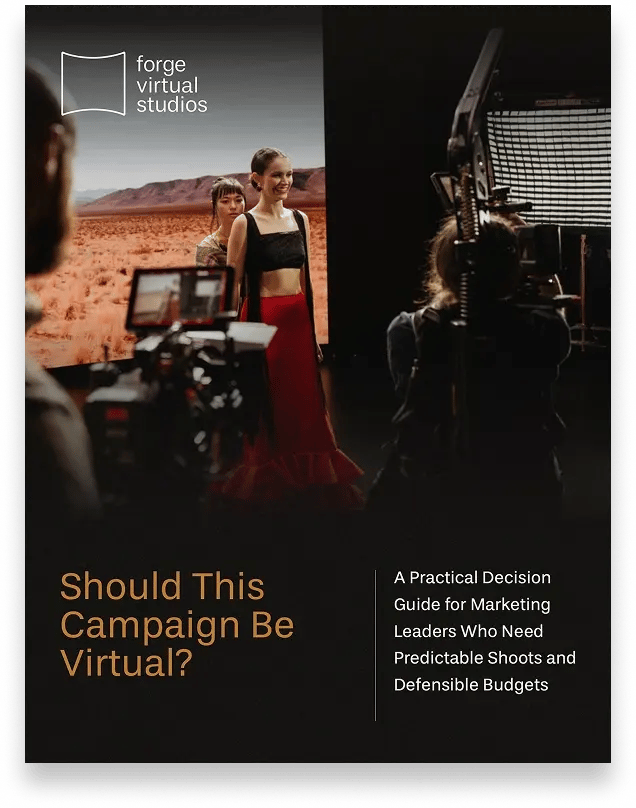
Is Virtual Production Right for Your Campaign?
It looks powerful on paper. This guide helps you determine if it actually works for your timeline, budget, and creative.
Virtual production can unlock ambitious ideas. It can also introduce complexity if it’s not the right fit. This decision guide is built for brand teams actively planning campaigns and needing a clear, production-ready answer.
The Factors That Actually Matter
01.
Cost & Tradeoffs
Know exactly where virtual production earns its cost and where it doesn’t. Compare approaches shot by shot so you can balance efficiency with creative control without overcommitting budget.
02.
Timeline Realities:
Virtual production shifts when decisions need to be made. From LED wall setup to tracking and lighting, understand what must be locked earlier to avoid delays once you’re on set.
03.
Flex vs Lock:
Not everything can change on the fly. Know what needs to be locked before shoot day and where you still have flexibility, so last-minute changes don’t create downstream issues.
Make the Call with Confidence
This isn’t a high-level overview of virtual production. It’s a practical tool for evaluating a real project. Built from real production scenarios, not theory.
Inside, you’ll learn how to:
-
Determine if your concept is a strong fit for virtual production
-
Identify where it adds value and where it introduces risk
-
Understand the production realities behind the approach
-
Move forward with clarity, not assumptions
Built for Teams Making Real Decisions
This guide is designed for brand and marketing teams actively planning a campaign or production.
If you’re weighing production approaches, aligning stakeholders, or trying to validate a direction before moving forward, this will give you the clarity you need.
If you’re just exploring virtual production at a high level, this may be more detailed than what you need right now.
Make the Right Call Before You Commit
Download the decision guide and evaluate your project against real production criteria.
Understand where virtual production will actually work for your campaign and where it won’t before you commit time, budget, or creative direction.
What Actually Determines Fit
Creative Requirements & Goals
Determine whether your concept actually benefits from controlled environments, complex visuals, or location flexibility or if a simpler approach would achieve the same result.
Budget Structure & Efficiency
Virtual production doesn’t always reduce cost. It reallocates it. Understand where it creates efficiency and where additional investment is required so there are no surprises late in production.
Timeline & Logistics
Production timelines shift with virtual workflows. Know what needs to be planned earlier and how setup, prep, and shoot days impact your schedule so you’re not making critical decisions too late.
Team & Production Complexity
Virtual production introduces tighter coordination across teams. Assess whether your team and partners can support the level of planning and execution required before moving forward.
What Happens After You Decide?
You’ve worked through the guide. Now it’s about applying it to your actual project. Whether you’re ready to move forward or still pressure-testing ideas, here are the most useful next steps based on where you are in the process.
Ready to See If It Works for Your Campaign?
If you have a specific project in mind, the next step is to pressure-test it.
We’ll look at your concept, timeline, and constraints, and help you determine whether virtual production is the right approach and what execution would actually look like.
Still Evaluating Virtual Production?
If you’re not fully decided yet, spend time understanding how virtual production actually works in practice.
The clearer you are on how it works in practice, the easier it is to make a confident decision when the right project comes along.
Need to Align Your Team Internally?
Use the decision guide as a tool to bring stakeholders into the conversation.
It’s designed to help teams align on feasibility, budget expectations, and production approach so you can move forward without uncertainty or misalignment. So everyone is aligned before production decisions are made.