7 min read

Ensuring Color Accuracy with LED Volume Walls & Cameras

Ensuring Color Accuracy with LED Volume Walls & Cameras
13:52

Virtual production has completely opened up the possibilities of imagination and creation on film sets. It has given filmmakers the ability to build entire worlds inside a LED volume wall and capture final-pixel imagery in real time.

With a LED volume stage, production teams can now directly visualize environments that once required complex location shoots, heavy VFX pipelines, or green screen guesswork—all through the lens. Directors, DPs, production designers, and clients can all see the world of the story as it truly appears, making collaboration faster, more intuitive, and more creatively fluid. But there’s one element that determines whether that virtual world feels believable or breaks immersion: color fidelity. And achieving accurate, consistent color quality inside an LED environment is far from simple.

The wall, camera sensor, content pipeline, lighting, and even on-set practical elements all interact in ways that can subtly—or dramatically—shift tones. Skin tones may appear cooler than intended, product colors may drift off-brand, and virtual backgrounds can lose depth if color is even slightly misaligned.

For teams working in virtual production, these discrepancies can create continuity issues, require costly fixes in post-production, or undermine the realism the LED stage is supposed to deliver.

Bridging the gap between the virtual environment and what the camera actually records separates a good virtual production from a flawless one. Achieving precise color means the digital world blends seamlessly with physical elements, preserving mood, tone, and visual consistency from shot to shot. And with the right tools, expertise, and workflows, filmmakers can trust that what they see on the wall is exactly what ends up on screen—no surprises in post, no compromises in quality.


Understanding LED Volume Walls in Virtual Production

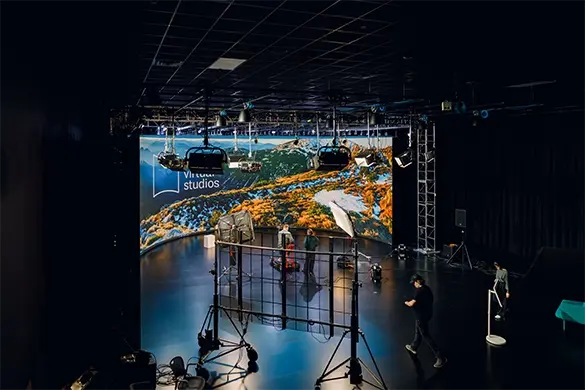
A modern LED volume wall is far more than a high-tech backdrop. It’s a dynamic, adaptive canvas that transforms how filmmakers design, light, and capture entirely new visual experiences. Built from hundreds or thousands of individual LED panels, a full LED volume stage surrounds talent with real-time, photoreal environments driven by engines like Unreal Engine. Instead of imagining what a final composite might look like months later, directors and cinematographers can see the world of the story fully realized through the lens. This immediacy has made LED volumes central to contemporary virtual production workflows.

Because the wall itself becomes both the light source and the environment, color performance is critical. Several technical metrics determine how faithfully a volume reproduces color and how well the camera will interpret that color.

Color gamut coverage is the first major factor. A volume capable of reproducing wide gamuts such as DCI-P3 or Rec. 2020 delivers more vibrant, realistic hues. This expanded range ensures skies don’t clip into cyan, foliage doesn’t flatten into uniform green, and subtle gradients — such as sunset tones or atmospheric haze — retain their natural richness.

Matching the color space between the graphics engine and the LED display is equally important. When Unreal Engine outputs one gamut and the wall expects another, even minor inconsistencies can introduce banding, hue shifts, or washed-out tones. Proper LED screen calibration ensures both systems speak the same visual language.

White balance is another foundational consideration. LED volumes often operate around color temperatures like 6100K, which must be dialed in precisely to ensure the camera perceives color the way the human eye would. The challenge grows more complex when you introduce practical fixtures on set. Ambient light emitted from the LED panels can influence skin tones and physical props, so balancing both sources is essential.

Finally, gamma correction shapes how depth, contrast, and luminance are perceived. Small changes in gamma can influence shadow roll-off or highlight density, affecting how seamlessly virtual and physical elements blend. When combined with the color rendering index challenges inherent in LED technology (such as narrow-band spectral emissions that struggle with complex tones like skin) maintaining consistent color and brightness across a large stage becomes an ongoing technical and environmental challenge.


Best Practices for Achieving Perfect Color Fidelity on LED Volume Walls

Getting exceptional color inside a LED volume virtual production environment is the result of a disciplined, repeatable workflow. Producers who understand the right steps can dramatically reduce surprises on set, prevent costly fixes in post, and ensure what’s captured in-camera matches the creative vision. Below is a practical, production-ready process for achieving flawless color inside any LED virtual production studio.


1. Calibrate the LED wall with precision

Proper LED wall calibration is the foundation of accurate color. Every panel in a LED screen stage emits light slightly differently due to manufacturing variances, heat, and aging. Hardware calibration evens out these discrepancies.

Key calibration steps include:

  • Panel-by-panel brightness and contrast tuning: Ensures uniform luminance across the entire wall, preventing hot spots or dim seams.
  • Color uniformity adjustments: Calibrates RGB output so hues remain consistent across the volume—critical when the camera pans or talent moves.
  • The white point test: A non-negotiable step, setting the correct white point ensures the LED wall produces a neutral baseline that matches the intended color temperature. For many volumes, this sits around 6100K–6500K, but it must be validated through meters, not guesswork.
  • Applying industry-standard color profiles: Whether using ACES, Rec. 709, DCI-P3, or a custom LUT, standardized profiles create a predictable pipeline from Unreal Engine to the wall to the camera.

Recommended maintenance:

  • Full calibration monthly for frequently used walls
  • Supplemental checks weekly
  • Immediate recalibration after replacing panels, updating LED processors, or changing wall layout

Skipping these steps is the fastest path to mismatched tones, unexpected color shifts, or inconsistent backgrounds.


2. Synchronize cameras and LED systems

To eliminate flicker, banding, or color anomalies, every device must operate in perfect sync.

Best practices include:

  • Genlock all hardware—the camera, LED processors, and tracking system must share a timing signal. Without genlock, the camera samples different moments than the wall displays, causing visible artifacts.
  • Match camera settings to wall output:
    • Shutter angle/speed must harmonize with the LED refresh rate
    • ISO should be set to preserve dynamic range while minimizing noise
    • White balance must match the LED wall’s calibrated white point—or be custom-balanced to the virtual environment
  • Use real-time monitoring tools: Waveform, vectorscope, and calibrated monitors ensure what the wall emits aligns with what the sensor interprets. Unreal’s color output should also be checked live to ensure no pipeline mismatches occur mid-shoot.

3. Integrate lighting intentionally

Even with a perfectly calibrated volume, the scene falls apart if the foreground light conditions don't match the virtual environment.

Lighting strategies for clean, natural results:

  • Blend LED illumination with practical lights: Use soft sources, negative fill, or directional key lights to match the brightness, angle, and color of the virtual sun or practical fixtures represented on the wall.
  • Match foreground and background hues: If the virtual environment has warm sunlight, talent cannot be lit with cool practicals. Color meters are essential for aligning sources.
  • Control saturated off-camera colors: Highly saturated reds or blues on adjacent panels can spill onto skin or reflective props in unnatural ways. Adjust off-camera content or apply flags/black wrap to prevent color contamination.

By combining tight calibration, synchronized camera workflows, and thoughtful lighting integration, producers can achieve the level of color fidelity that makes the virtual world indistinguishable from the real one—all inside the controlled environment of a modern LED volume.


Advanced Techniques for Seamless Color Results: HDR, Live Monitoring & Custom LUTs

On a modern virtual production stage, achieving perfect color goes beyond calibration and camera matching. Advanced workflows—HDR imaging, precision monitoring, and custom LUT development—give filmmakers even tighter control over how virtual and physical elements blend. These techniques help ensure what appears on the LED wall looks accurate and feels cinematic, consistent, and production-ready.


HDR Workflows & Color Space Management

Implementing HDR inside LED stages requires aligning every component of the pipeline to support expanded dynamic range and richer color gamuts. That starts with configuring the graphics engine to output HDR content using a wide-gamut color space such as Rec. 2020 or ACEScct. The LED processors must be set to accept and faithfully reproduce this signal, ensuring the emitters display deeper blacks, brighter highlights, and smoother gradients without clipping or banding.

The result is a dramatically more lifelike environment. HDR enhances volumetric lighting, atmospheric effects, reflective surfaces, and nighttime scenes, making them feel more dimensional and convincing on camera. Expanded color gamuts allow the wall to render richer blues, saturated reds, and subtle skin tones with far greater accuracy, helping the virtual world blend seamlessly with real-world props and talent.

When executed correctly, HDR workflows deliver virtual environments that hold up under cinema-grade lenses and large-format sensors—raising the ceiling for what’s visually achievable inside an LED volume.


Real-Time Monitoring and Analysis

Live color analysis is essential for maintaining consistency inside an LED virtual production studio as environments, lighting cues, and camera angles shift throughout the day. Professional spectrometers like the Sekonic C-800 and C-7000 provide precise, real-time measurements of color temperature, spectral output, and CRI/TLCI values directly from the LED wall and practical fixtures. This allows teams to immediately detect shifts caused by heat, panel aging, or content changes before they become visible on camera.

Waveform monitors, vectorscopes, and color-gamut visualization tools further enhance on-set accuracy. These instruments reveal clipping, hue drift, saturation spikes, and luminance inconsistencies that may not be obvious through an uncalibrated monitor.

By combining spectrometer readings with these visual tools, crews can correct issues on the fly, so every take—regardless of angle or lighting setup—maintains the intended color balance and integrates smoothly with foreground elements.


Custom LUTs and Color Pipelines

Creating custom LUTs is one of the most effective ways to maintain color fidelity from the earliest stages of pre-production through final color grading. The process begins with defining a target look—often derived from concept art, brand guidelines, or a DP’s preferred tonal palette.

A base LUT is then built to translate that creative intention across the entire imaging chain: Unreal Engine output, LED wall display, camera sensor response, and on-set monitoring. When applied consistently, this LUT becomes the visual anchor for the shoot.

With a well-structured color pipeline, every department speaks the same visual language. The art team designs environments that align with the LUT’s contrast and saturation profile; the lighting team balances sources to match the intended white point and color space; and the colorist finishes footage knowing the on-set look was captured accurately, not approximated. By standardizing this workflow, productions eliminate accidental shifts in tone or contrast and protect the creative vision from scene to scene, camera to camera, and shoot to final delivery.


Create Stunning, Color-Accurate Visuals with Forge’s LED Volume Wall

True color accuracy on a LED volume wall is the foundation of believable, high-impact virtual storytelling. From calibration and white-point tuning to HDR workflows, custom LUTs, and real-time spectrometer analysis, every step plays a role in matching what you see in-camera with creative intent.

When these practices come together, productions gain the confidence that every frame will hold up under scrutiny, blend seamlessly with practical elements, and retain the emotional tone that audiences expect.

While these techniques can be complex, they’re essential to unlocking the full potential of modern virtual production. With a well-planned workflow, even the most demanding scenes can be captured with consistency and precision inside a LED virtual production studio.

At Forge Virtual Studios, our team, state-of-the-art technology, and processes are built to support color-critical workflows from pre-vis through final delivery. With hands-on guidance and expertise, you can focus on creative impact, not technical uncertainty.

Ready to create stunning, color-accurate visual productions? Schedule a consultation with the Forge team today.

About the Author
Drew English

Drew is the co-founder and CEO of Forge Virtual Studios. He frequently writes about the intersection of craftsmanship, creativity and technology in the film industry, as well as creative entrepreneurship. You can keep up with Drew's thoughts and other Forge updates by following him on LinkedIn.


Real-Time VFX in LED Volume Studios: Tools and Techniques

Real-Time VFX in LED Volume Studios: Tools and Techniques

Filmmaking has always evolved alongside the tools that support it. As creative expectations rise and timelines shrink, teams need workflows that...

Read More about this blog
Fixing Color Shifts Caused by LED Panels in LED Wall Studios

Fixing Color Shifts Caused by LED Panels in LED Wall Studios

When you step onto an LED volume stage, you can instantly feel the magic of creative potential. But for all of virtual production’s powers, the...

Read More about this blog
Virtual Production & Post-Production: How They Work Together

Virtual Production & Post-Production: How They Work Together

Anyone who’s spent time on a set in recent years has seen that the way we make stories is changing. Not in a theoretical “future of film” way, but in...

Read More about this blog