Driving Plates in Virtual Production: How Car Scenes Get Shot on an LED Wall
Driving scenes can make a car spot stand out by showing a vehicle in its best light — or add visual movement and action to an otherwise ordinary...

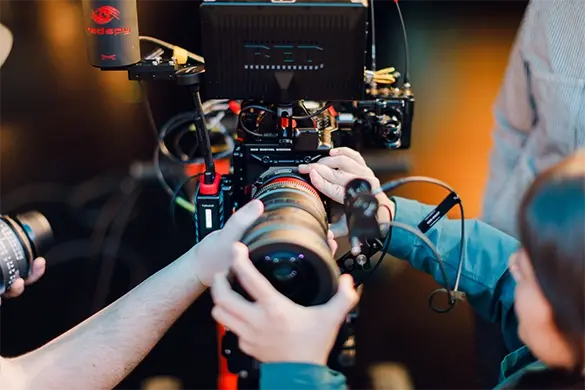
Step onto a virtual set, and suddenly, the familiar boundaries of the real world begin to soften. What makes this transition believable isn’t just the art on screen. It’s camera tracking, which works quietly in the background to integrate between real cameras and virtual set backgrounds.
Think of it as your behind-the-scenes partner that allows a physical camera’s every move to be echoed perfectly inside the virtual space. With each pan and tilt, the virtual environment responds in real time, preserving the illusion and keeping your cast and crew immersed in the story.
When camera tracking is precise, everyone on set, from producers to filmmakers to actors, can trust that the world they’re performing in stays anchored and convincing. If that delicate balance falters, the spell breaks, and the magic slips away.
At Forge Virtual Studios, we believe in making this technology accessible and intuitive. Camera tracking may seem complex at first. However, it should empower you by turning complicated tasks into a chance for creativity.
Every production comes with its own challenges and goals, which means there’s no one-size-fits-all camera tracking method. On today’s virtual production stages, the variety of tracking systems gives you the tools and flexibility to shape your unique story.
Finding the right approach is about matching technology to vision and workflow—and it starts with understanding the strengths and limitations of each system.
Mechanical tracking is a cornerstone technique that’s trusted for reliable results on LED virtual production stages. This method uses precise encoders and sensors, installed right on your camera’s support—tripod, dolly, or crane. Every pan, tilt, zoom, or focus pull is turned into data. This data goes directly to the graphics engine, which lets your virtual backgrounds move with your camera.
The dependability of mechanical tracking makes it a favorite for teams who need consistent results, even in challenging lighting or when set pieces move into frame. Because this system doesn’t require visible markers in the physical set, it lets you bypass many common tracking headaches.
There is, of course, a trade-off: flexibility. Mechanical systems pair best with fixed rigs and are less suited to handheld or highly mobile camera work. To keep everything running smoothly and in sync, you need regular, attentive calibration. If your scene calls for precision and predictability, mechanical tracking is a tried-and-true partner.
When a production calls for freedom of movement and seamless integration between camera and environment, optical tracking takes the spotlight. This system uses infrared cameras to follow the position and rotation of your physical camera in real time.
There are two main approaches: outside-in and inside-out.
In an outside-in setup, infrared cameras are placed on top of the LED wall. They face inward to track a small device on the filming camera. As the camera moves within the volume, these sensors calculate its exact location and orientation. This method is effective for many controlled setups, but requires the tracking cameras to maintain an uninterrupted line of sight to the tracked device.
An inside-out system flips that configuration. Here, a compact infrared camera is mounted directly on the production camera itself. It points upward toward a constellation of reflective “star map” dots installed across the studio ceiling.
As the camera moves through space, the sensor reads the star field. It constantly sends position data to the graphics engine. This design allows for fast, fluid movement—even when walls or set pieces block the LED screens—making it ideal for handheld, Steadicam, or dynamic dolly work.
At Forge, our virtual studio sets rely on the Stype RedSpy, a leading inside-out tracking system known for precision and adaptability. This technology anchors every shot on our LED stage, ensuring virtual video production environments respond instantly and accurately to the camera’s motion.
Not every production fits neatly into one tracking category. That’s where hybrid tracking systems step in. This method combines the strengths of mechanical and optical methods to achieve maximum flexibility and precision.
In a hybrid setup, data from mechanical encoders (attached to tripods, cranes, or dollies) merges with optical tracking information captured from infrared sensors. This fusion gives the consistency of mechanical tracking and the range of motion offered by optical systems.
The benefit is redundancy and reliability. If one data stream experiences signal interference or a brief loss of line-of-sight, the other continues feeding accurate position data to the graphics engine. You get smoother movement, stronger depth alignment, and a system that’s more forgiving in complex or unpredictable environments.
Hybrid methods are especially valuable on virtual production stages that involve both fixed and moving cameras, or when multiple tracking technologies need to communicate seamlessly within a single workflow. Whether capturing high-speed action or subtle camera moves that demand pixel-perfect precision, hybrid tracking ensures the virtual and physical worlds stay in sync.
Camera tracking connects the real and the digital on virtual set environments through precise, real-time calibration. Each of the physical camera movements is mirrored instantly within the virtual world using synchronized data and powerful visual engines.
When integrated correctly, this process reduces the need for time-consuming post-production tracking, allowing teams to see the finished shot as they film. The result is a seamless, natural visual experience where every move feels grounded and believable.
Every fluid camera move inside virtual studios depends on the system’s ability to capture motion data at lightning speed. Tracking sensors record the camera’s exact position, rotation, and lens adjustments hundreds of times per second, often sampling at rates above 120 fps to maintain peak accuracy.
This high-frequency data is collected from multiple inputs—encoders, infrared markers, or ceiling-mounted sensors—that constantly talk to each other to map the camera’s location in three-dimensional space. Together, they create a live feedback loop that keeps the physical and virtual perfectly aligned.
Before filming begins on an LED volume stage, precision calibration is critical. This ensures the physical and virtual worlds occupy the same space. The process starts by aligning coordinate systems, or mapping where the real camera is in relation to the digital environment. This way, both can share a consistent point of reference.
Camera and lens calibration follow, measuring how the lens behaves at various focal lengths and focus distances. This data defines how the virtual lens should respond, ensuring that depth of field, perspective, and parallax match perfectly between real and rendered elements.
Distortion mapping and sensor characterization further refine the alignment. These steps compensate for subtle optical quirks (like lens curvature or sensor offset) that could otherwise cause mismatches between layers of the image. When calibration is dialed in with this level of precision, the illusion is indetectable.
Once tracking and calibration are complete, the data flows directly into the real-time rendering engine. This is the creative core that unites the physical camera with its digital twin. Every frame of movement is translated instantly, allowing the virtual camera to mirror the real one with pixel-level precision.
Inside engines like Unreal, this harmony drives how the environment behaves on the LED volumes. As the camera shifts perspective, the rendered background adjusts accordingly, maintaining accurate scale, depth, and motion parallax. The LED volume virtual production walls themselves become a living extension of the lens, updating in real time to preserve spatial continuity.
Because compositing happens live, teams can see virtual elements interact naturally with lighting, reflections, and performance. This tight integration gives directors and DPs immediate feedback, making the virtual stage into a true extension of the filmmaking toolkit.
Within an LED virtual production setup, precise camera tracking is an investment that elevates every stage of the creative process. When tracking is accurate, the connection between camera and LED panels unlocks a level of realism and efficiency that traditional shoots can’t match.
When executed with precision, expert camera tracking pays dividends in realism, collaboration, and production cost efficiency.
As virtual studio sets continue to evolve, camera tracking is expanding far beyond single-camera shoots. Advanced applications enable filmmakers to push creative and technical boundaries through multi-camera workflows, real-time compositing, and mixed-reality experiences. These innovations allow production teams to move faster, capture more complex scenes, and visualize finished shots directly on the LED volume stage.
In large-scale productions, multiple cameras often need to operate simultaneously within the same virtual environment. Each camera must maintain its own independent tracking data—position, rotation, and lens parameters—without interfering with the others. This synchronization ensures every angle remains consistent, allowing editors to cut seamlessly between shots.
In an LED studio, this coordination relies on unique tracking identifiers for each camera, real-time calibration, and shared spatial reference points that ensure perfect alignment. But beyond software precision, smart connectivity is key. Advanced virtual production studios, like Forge, are equipped with fiber optic solutions such as MultiDyne, which transport power, control (including critical Genlock signals), and video through a single, high-speed line.
This approach eliminates the tangled mess of copper cabling and simplifies setup dramatically. Forge’s system combines up to ten separate signals into one fiber cable—supporting two fully tracked cameras. The result is a cleaner, faster, and more reliable infrastructure for multi-camera virtual videography.
In-camera visual effects, or ICVFX, have become a cornerstone of modern virtual production. Using precise camera tracking and real-time rendering, filmmakers can composite live-action footage with digital backgrounds directly on set (no green screen or post-production replacement required).
Each tracked camera feeds positional and lens data into the rendering engine, which generates a perspective-correct background on the LED volume stage. As the physical camera moves, the digital environment adjusts instantly, maintaining accurate parallax and lighting. This process allows the crew to capture final-pixel imagery in real time.
ICVFX also streamlines virtual production studio collaboration as directors, DPs, and VFX artists can see the finished shot as it’s being filmed. From sci-fi landscapes to complex reflections and shadows, in-camera effects give teams the power to create high quality cinematic visuals efficiently.
Augmented reality (AR) is emerging as a powerful extension of camera tracking technology. By overlaying digital objects or graphics into real-world environments, AR enables filmmakers and broadcasters to merge the physical and virtual in new, dynamic ways.
On an LED virtual production stage, AR tracking allows virtual elements—such as holographic interfaces, data visualizations, or 3D objects—to stay perfectly anchored in space as the camera moves. This fusion of live-action and virtual layers enhances storytelling for film, television, and live events. For example, broadcasts can visualize live stats on stage, event producers can blend performers with digital worlds, and directors can preview CG assets during pre-vis.
Mastering camera tracking is the key to unlocking the full potential of your virtual production. From precision calibration to seamless real-time rendering, every step determines how convincing and efficient your production can be. At Forge Virtual Studios, we combine cutting edge technology with hands-on expertise to help creators bring stories to life, no matter the scale or scope of the project.
We believe innovation is only valuable when it’s usable. That’s why we prioritize accessibility, reliability, and collaboration across every production we support. Whether you’re filming a commercial, a cinematic short, or a large-scale broadcast, we work beside you to ensure your camera tracking setup performs flawlessly from start to finish.
By partnering with Forge, you gain a technical resource and, more importantly, a creative ally. Together, we’ll streamline your workflow, elevate your visuals, and give your team the confidence to create without limits.

Driving scenes can make a car spot stand out by showing a vehicle in its best light — or add visual movement and action to an otherwise ordinary...
Light-emitting diode (LED) volumes revolutionize what filmmakers can achieve, but this process isn't automatic. The work put in by art directors...
Brands face intense pressure to keep up with always-on social media feeds while differentiating themselves from the competition. Many of these brands...