Driving Plates in Virtual Production: How Car Scenes Get Shot on an LED Wall
Driving scenes can make a car spot stand out by showing a vehicle in its best light — or add visual movement and action to an otherwise ordinary...

Brands face intense pressure to keep up with always-on social media feeds while differentiating themselves from the competition. Many of these brands get bogged down by traditional, multi-location, or green screen productions. These once-effective strategies limit brands' ability to meet the pace and volume that modern social media video production now demands.
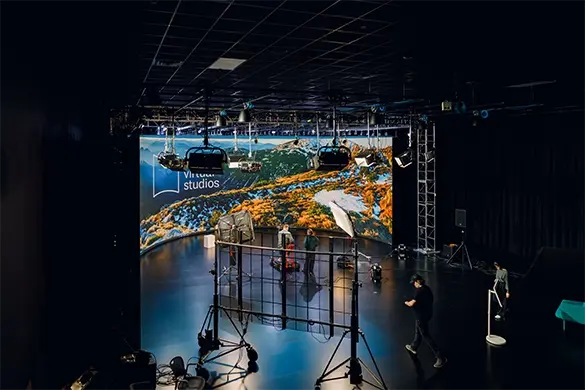
The one-day virtual studio model offers a scalable, much less time-consuming alternative. With light-emitting diode (LED) volumes, brands can capture 30+ assets in a single day without compromising their authentic voice or cinematic quality.
Explore the top benefits of using an LED volume for social media content, including scalability, visual quality, predictability, and streamlined post-production processes.
Social media, streaming services, and a continuous demand for more content have completely changed the world of brand marketing. Many markets and niches are oversaturated with brands making competing content at a massive scale. The brands standing out are meeting that demand for scale while also differentiating their stories and messages with authentic, visually engaging films.
Branded social content production hinges on both quantity and production quality — not one at the expense of the other. This has led many brands to reassess how they approach the production process, including the best environments and studios to work with.
Traditional production shoots at physical, real-world locations pose various drawbacks, including real costs and inefficiencies.
Productions often have to pay more for permit fees, travel, and amenities when filming at external locations. Outdoor locations can also pose weather risks that can delay production and significantly raise your budget, as a result. Transportation, weather delays, and challenges maneuvering equipment in a new location can all slow down production and take away from the time spent on the actual filming processes. Productions often need multiple shoot days to capture everything they need, especially when preparing campaigns.
Add to that lack of predictability. Beyond weather, the sun's movement can cause lighting and shadows to change during the day. This hinders continuity and further limits the time directors have to capture their vision, especially when filming during golden hour.
Single studio production days solve that, allowing teams to save money and time while restoring a sense of predictability across the filming process. Technology, such as LED volumes for branded content, helps brands protect their return on investment (ROI) without sacrificing production quality.
Virtual studios let crews film in front of photorealistic backgrounds with real-time rendering and parallax. Brands can film during "golden hour" for eight hours straight or direct daylight in a precise direction that's consistent between each shot — no rush, no continuity issues, and no weather risks.
The same math works beyond in-house teams. Agencies can also book a single studio day, and they can split it across several retainer clients or dedicate it to one client's full quarter of content. Instead of scheduling separate shoots for each brand, the agency captures a month of material for multiple clients in one sitting, swapping backdrops and talent between setups. It's a repeatable, high-margin way to keep every client's feed full while giving them a premium, client-ready experience on set.
Using an LED volume for social media content expands practical, technical, and creative possibilities on the film set. Virtual art department (VAD) and volume ops teams can change the background location without requiring any transportation or relocation. This allows teams to seemingly film at multiple locations, leverage multiple content themes, or create content for multiple campaigns in one, single-location day.
Virtual studios allow brands to leverage two workflows. 2D plate workflows use pre-rendered backgrounds for shots with minimal camera movement. This simpler approach prioritizes speed and repeatability during production, allowing teams to quickly capture content without resetting or calibrating between takes. Real-time 3D environments, by contrast, use live rendering and camera tracking that respond to every move, creating depth, scale, and parallax that reflection-heavy or dynamic shots need. They create dynamic visuals and support on-set creativity and reflection-heavy projects, but they take longer to capture.
The number of social media videos you can batch into a single day depends on the type of content you want to produce. For instance, you could likely film a few dozen 15-second spots against 2D-plate backgrounds, especially with sufficient rehearsal beforehand. Alternatively, you could film a handful of complex 30-second social media ads using 3D rendering and in-camera visual effects (ICVFX), even if each film needs multiple locations.
Forge Virtual Studios helped Riverwood Capital film 30 interviews in a single day of virtual production. Continuous shooting and rapid look changes enabled high-level production efficiency while allowing the marketing team to leverage dynamic backgrounds and visuals. The final delivery was polished, it arrived on schedule, and it didn't go over budget, giving the brand 30 assets to use or build upon in their campaigns.
"Virtual production helped us film 30 interviews in one day with distinct, dynamic backdrops—delivering a polished, on-time, and on-budget shoot." - Caitlin Mitchell – Senior Director of Marketing, Riverwood Capital
Traditional green screen productions allowed studios to scale out their campaigns. However, these films required extensive post-production time and often looked artificial, especially without effective lighting, art design, or editing.
Virtual environments created with LED volumes and experienced VAD teams don't have these issues. Both cinematic 2D plates and immersive 3D environments read as polished and photorealistic when calibrated and colored correctly. For instance, interviews and talking-head videos often use Unreal Engine 2D plates to display simple yet dynamic backgrounds, such as shapes slowly moving against a color gradient. These types of backdrops are engaging enough to grab viewers' attention without taking their focus away from the speaker.
The premium look of virtual studio social media films offers a crucial branding advantage by distinguishing the films from disposable social clips. High-quality visuals and intentional, narratively-driven cinematography tell viewers that your brand actually has something to say.
Furthermore, these digitally rendered worlds give you unmatched opportunities to build a lasting and recognizable brand identity. For instance, you could weave brand colors into the background or recreate familiar, nearby landmarks to appeal to local audiences.
You can then reuse these assets and color palettes across campaigns and deliverables to support consistency and recall. Viewers who watched your first brand film to the end may immediately recognize your brand if your next film uses similar colors or backgrounds. This can help you follow the 3-7-27 rule of marketing, which suggests viewers must see content three times to notice a brand, seven times to remember it, and 27 times to fully trust it.
Another critical advantage of using an LED volume for branded content is the reliability. You can effectively avoid many of the biggest risks of traditional production, including:
Virtual production gives brands a greater sense of predictability when planning, scheduling, lighting, and other production logistics, ensuring you know what to expect on your first day. Now, brands can film in bright, seemingly outdoor settings while keeping their workflows independent from the weather and other external factors. Eliminating risks and limitations ensures directors can instead focus on innovative and creative storytelling for brand content.
These predictable, repeatable conditions are especially beneficial for long-term marketing and branding goals. Now, you can continuously expand upon your initial campaign by reusing the same familiar backgrounds without repeatedly dealing with the same traditional production logistics and risks.
Virtual studios also offer amenities, such as green rooms and break rooms. These on-site experiences are often more comfortable for clients and talent than bare warehouses or outdoor park benches. While this may seem small, studio amenities offer a much-needed sense of predictability and peace of mind for project management.
Post-production editing and recoloring can eat up your distribution scheduling, especially if you're relying on green screens and visual effects (VFX). Capturing the final look live using an LED volume can cut this time down significantly. By combining various steps of virtual production and post-production, you can share your new brand content much faster.
Besides saving time, in-camera VFX for social content eliminates the guesswork typically reserved for post-production. When filming on a green screen, production crews often had to guess how the final product would look or edit the green screen out of footage while they were still on set. Now, the entire crew (and even the talent) can see how the final product will look before the camera rolls. This allows them to make slight adjustments to background elements, physical art design, and performances on the day.
This speed and efficiency are especially ideal for capturing multiple deliverables from one shoot. For instance, your brand could first produce a longer cut of your film, which you could then trim down to social media cuts.
Virtual studio social media videos can level up your branding strategy, but treating this type of content as a one-off strategy is a missed opportunity. Studio production days operate best as a recurring part of your content strategy, allowing you to continuously develop your brand identity and build upon what you learned from your last campaign.
This approach allows you to establish planned production cycles rather than getting sucked into the constant-drip stress of reactive content. Long-term scalability makes it easy to build campaigns off of one another, and a predictable planning rhythm lets you easily adapt to market trends and new audience priorities.
Forge Virtual Studios helps brands streamline their social media video production by letting them leverage two different LED volume stages. With a 25' x 13' LED wall built with 2D plates, Stage B offers the ultimate hub for social and branded content.
Contact Forge to see the space for yourself and plan a high-volume shoot — and explore our blog for more insights on how virtual production supports volume, quality, and efficiency.

Driving scenes can make a car spot stand out by showing a vehicle in its best light — or add visual movement and action to an otherwise ordinary...
Light-emitting diode (LED) volumes revolutionize what filmmakers can achieve, but this process isn't automatic. The work put in by art directors...
Brands face intense pressure to keep up with always-on social media feeds while differentiating themselves from the competition. Many of these brands...